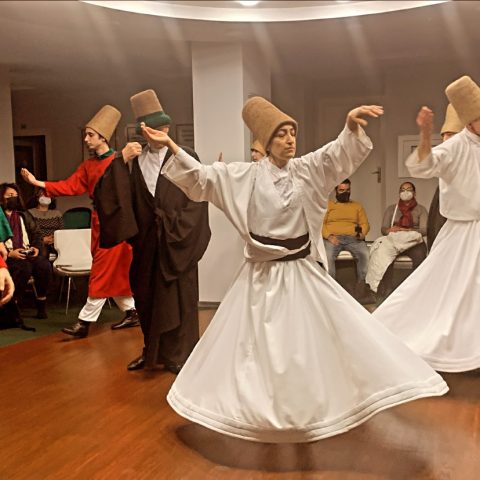
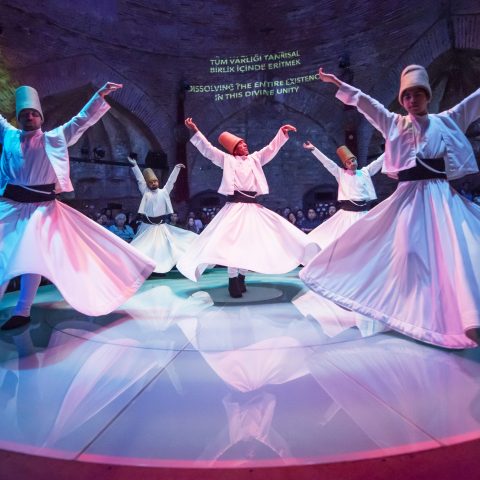
The Spanish author of Rumi books, Halil Barcena, held a discussion on ‘Sufism from East to West’ and a book launch at the Istanbul Cervantes Institute, which runs Spanish language courses in Istanbul. During the talk, he shared his knowledge with us through discussions on mysticism, a performance featuring whirling dervishes and the ney flute, the profound words of Mevlana, and a question-and-answer session. We, as lovers of Sufism, had the opportunity to attend this talk and meet him in person. For this reason, we would like to extend our sincere thanks to Halil Barcena, the author whose work focuses on Sufism. We hope he will return to Istanbul in the coming years.
https://www.instagram.com/halil.barcena.bcn
https://www.instagram.com/institut.d.estudis.sufis.bcn/
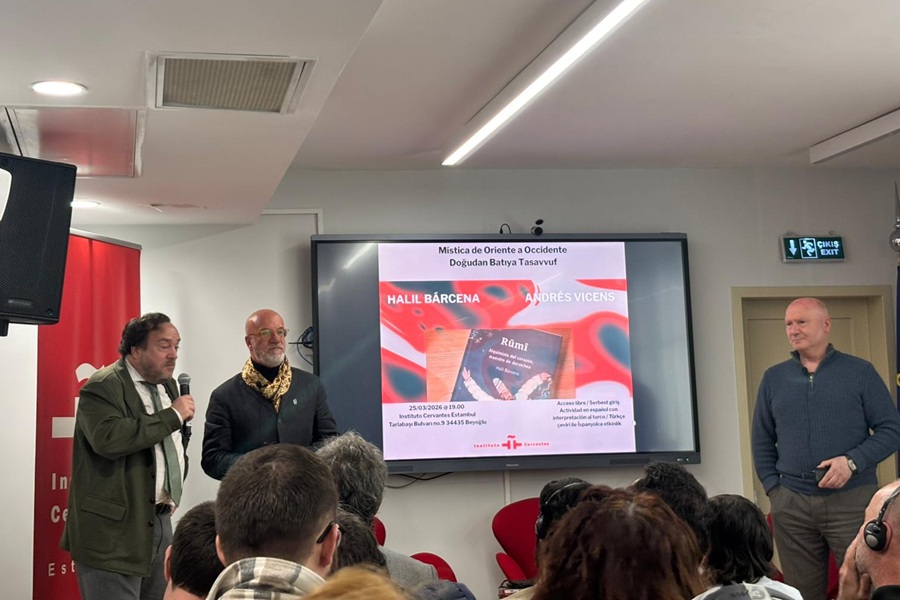
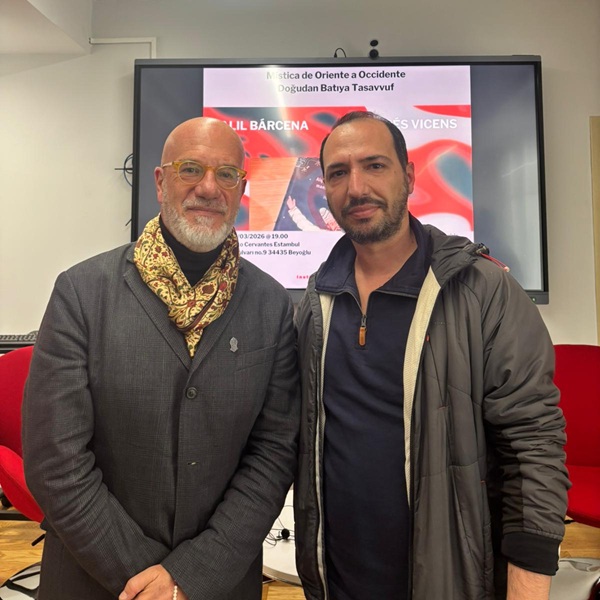
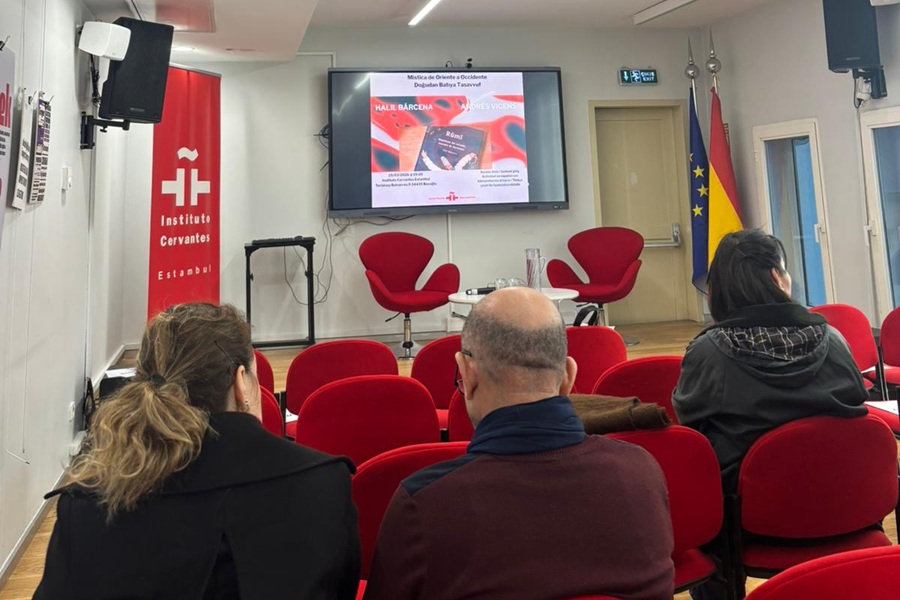
Who is Halil Barcena ?
Halil Bárcena (Renedo, Cantabria, 1962) is an Islamic scholar specializing in Sufi wisdom, based in Barcelona since 1983. He holds a PhD in Philology from the University of Barcelona, with a dissertation on the symbolism of the ney (Sufi reed flute) in the Sufism of Mawlânâ Rûmî (1207-1273). He also holds a degree in Information Sciences (Autonomous University of Barcelona), a diploma in Arabic Language (Official School of Languages of Barcelona), a master’s degree in Euro-Arabic Studies (University of Girona), and a diploma in Advanced Studies in the Humanities (Pompeu Fabra University). He has pursued Islamic and Arabic philological studies at various academic institutions in Morocco, Jordan, Lebanon, and Syria.
He has also studied Turkish musicology and is a ney player. As a musician, he founded the Sufi music group ‘Ushâq in 2000, with whom he recorded the CD ‘Ushâq. Sufi Music’ (2010). Halil Barcena also studies Islamic calligraphy, having been a student of the Turkish calligraphers Hüseyin Kutlu and Ali Riza Özcan.
He regularly contributes to various media outlets and specialized publications. He is a contributor to the Turkish literary magazine Yedi Iklim. He has taught in several master’s programs at various Catalan and Spanish universities; and in 2007, he was a visiting professor at the National University of Heredia (Costa Rica). A tireless traveler, he is familiar with much of the Islamic world, having visited the three holy cities of Islam: Mecca and Medina (Saudi Arabia), and Jerusalem (Palestine). He is the director of the Institute of Sufi Studies of Barcelona, an institution he has led since its founding in May 1998.
His Books ;
Sufismo – Halil Barcena
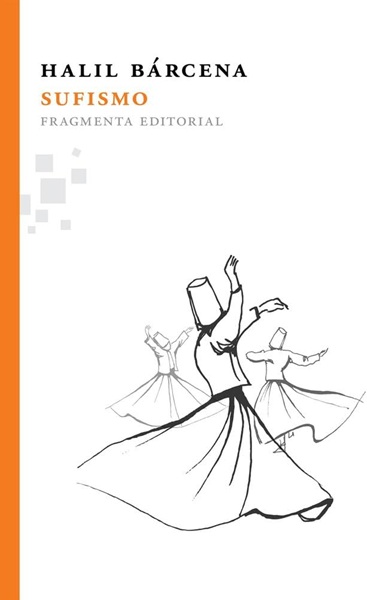
Sufism is a radical commitment to a free spirituality, devoid of any kind of submission or accommodating attitude. A spirituality that goes far beyond any formal constraints.
Sufism, or tasawwuf, constitutes the inner dimension of Islam, the nectar of Muhammadan spirituality, the purest and most refined distillation of the Quranic message. Sufism is the heart of Islam and, at the same time, the Islam of the heart. Despite its Islamic affiliation, Sufism, viewed from a universalist perspective, points toward the same horizon of spiritual meaning as many other paths of human fulfillment found in the various religious traditions of the world. Hence, according to the Sufis themselves, there is something in every religion that coincides with Sufism, which explains why Sufi literature contains expressions alluding to Sufism in other religions.
Perlas Sufíes – Halil Barcena
Saber y sabor de Mevlânâ Rûmî
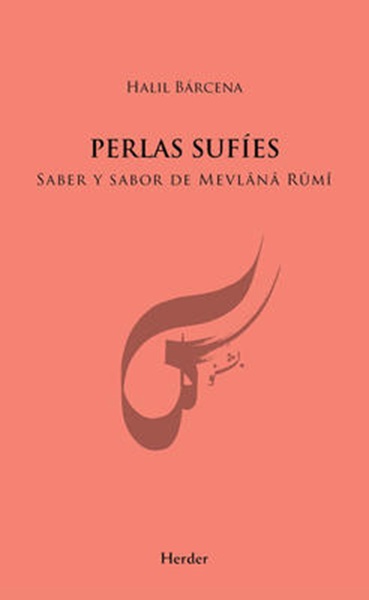
Mevlânâ Rûmî (1207, Balkh, Afghanistan – 1273, Konya, Turkey) represents one of the pinnacles of universal spirituality. An inspiration to the Sufi school of whirling dervishes, known for their circular dance, Rûmî is the author of a vast body of poetic work in Persian that stems from the joy of the unitive experience with God.
The Sufi pearls that Halil Bárcena has collected in this volume, translated directly from the Persian, constitute a kind of anthology of the wisdom and essence of the Sufi master. They reflect the cardinal aspects of his spiritual philosophy, whose aim is to show humankind the path back to its lost and forgotten identity: the Center from which everything emanates and from which nothing separates. Each of these pearls is accompanied by a commentary that seeks only to bring us closer to Rûmî’s thought and invite us to engage in our own meditative reading.
This edition includes twenty calligraphies that recreate, in a style inspired by the Ottoman calligraphic tradition, key words and initiatory formulas, in Arabic, Turkish and Persian, subtly introducing us to the spiritual universe of Rûmî.
Rûmî – Halil Barcena
Alquimista del corazón, maestro de derviches
There are authors who only achieve fame through their written works; outside of them, they are nonexistent. This is not the case with the Persian Sufi poet and sage Mawlânâ Rûmî.
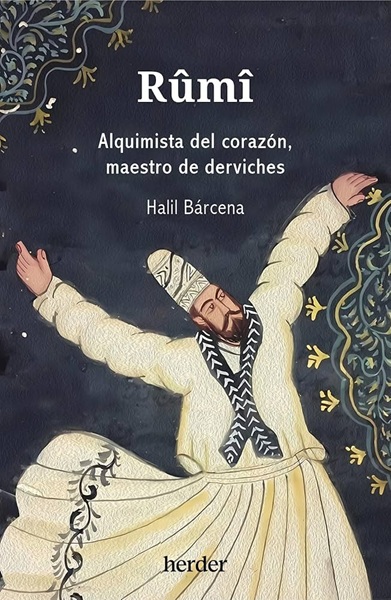
Rûmî (1207-1273), besides being one of the most inspired voices not only of Islamic mysticism but of universal spirituality, was a precursor of the Sufi school of whirling dervishes, famous for their hypnotic circular dance, about which Rilke said that “it is the true mystery of the prostration of the person who kneels from within.”
Who is this poet and sage of Sufism, acclaimed today by multitudes throughout the world? How did he transform from a sober and upright Muslim jurist into a fervent celebrant of the mysteries of divine love? These are the questions that the expert Islamic scholar Halil Bárcena attempts to answer, not only by delving into the life of Rumi, but also by offering us the interpretive keys to understanding his vast poetic work.
The reader has before them the first biography of Rumi written in Spanish, and its author, the Islamic scholar Halil Bárcena, is perhaps the foremost expert on Rumi in the Spanish-speaking world.
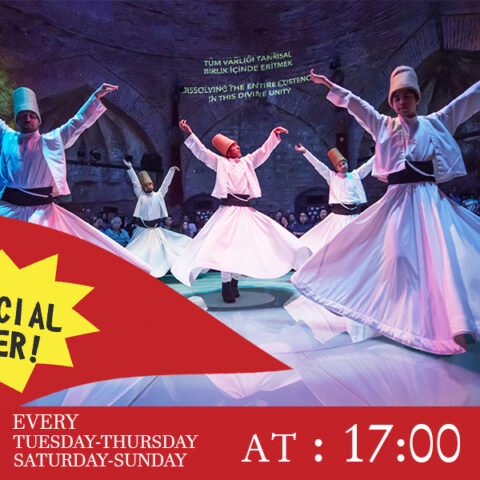
If you want to watch Whirling Dervish Ceremony in Istanbul you can see options down below
Recommended products
-
Real Whirling Dervish Ceremony in Fatih Every Thursday at 20:00 and Saturday at 19:00
Original price was: 1.900,00₺.1.890,00₺Current price is: 1.890,00₺. -
Special Offer !! at 17:00 Whirling Dervish Ceremony in Hodjapasha Culture Center
Original price was: 1.900,00₺.1.150,00₺Current price is: 1.150,00₺. -
Whirling Dervish Ceremony in Hodjapasha Culture Center
Original price was: 1.900,00₺.1.850,00₺Current price is: 1.850,00₺.
Key Words;
Sufism from East to West,Halil Barcena,Islamic mysticism,Rumi written in Spanish,Sufism,Mawlânâ Rûmî,spiritual universe of Rûmî,maestro de derviches,Ottoman calligraphic, Halil Bárcena,Perlas Sufíes,Saber y sabor de Mevlânâ Rûmî,Sufism or tasawwuf, Ushâq Sufi Music,Istanbul Cervantes Institute,mysticism